
June to September is the classic dry season, but September and January may be the smartest months. A month-by-month guide to weather, wildlife and prices.
The best time to visit Sao Tome and Principe is the gravana, the main dry season, from June to September. These are the months with the least rain, the roads in their best state, a calm sea and the humpback whale season. There's also a shorter dry spell, the gravanito, roughly between December and February, which many travellers overlook.
That said, this is an equatorial country: there's no bad time here, just different times. If you're interested in turtles, the rainforest at its lushest or travelling with fewer people around, the answer changes.

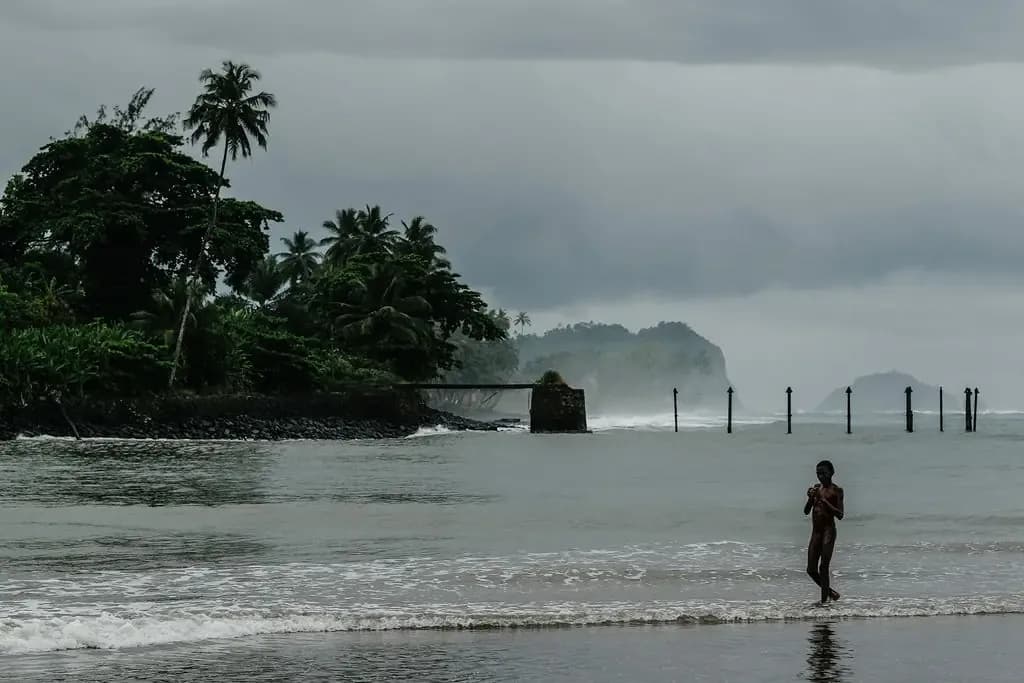
A São Tomé beach on a day of tropical rain. Photo: Príncipe Collection
The climate in a nutshell
The archipelago sits right on the equator, so there's no winter or summer. The average temperature is around 25 °C all year, with highs of 28–31 °C and lows that rarely drop below 21 °C. The sea stays between 26 and 29 °C twelve months a year.
What changes isn't the temperature but the rain and humidity. And there's a second factor that almost nobody mentions: the south of the island gets far more rain than the north. The area around Porto Alegre and Pico Cão Grande is true rainforest; the area around Lagoa Azul in the north is almost dry, with baobabs. You can have a downpour in the south and full sun in the north on the same day.
The two seasons
The gravana (dry season): June to September
- Little rain, clearer skies
- Lower humidity and slightly cooler nights
- Southern roads at their best all year
- Calm sea and better visibility for diving and snorkelling
- Humpback whale season
- Drier, duller vegetation, especially in the north
- High season: flights and accommodation cost more, especially during UK school holidays
The rainy season: October to May
- Short, heavy showers, usually in the afternoon or early morning
- High humidity, a heavier atmosphere
- Lush rainforest and waterfalls in full flow
- Sea turtle nesting season
- Southern roads take more of a battering
- Fewer travellers and better prices
The gravanito: December to February
Within the rainy season there's a short dry break known as the gravanito, which usually falls around January. It's one of the best-kept secrets of the Santomean calendar: good weather, still plenty of green, shoulder-season prices and very few people. It also coincides neatly with the depths of the British winter.
Month by month
January: highly recommended
The gravanito brings sunny days in the middle of the wet season. Turtles are nesting, the landscape is green and there are fewer travellers than in summer. Excellent value.
February and March: good
February is often still gravanito, with good beach weather; in March the rain returns, in short bursts. Turtle season continues. Among the cheapest months of the year to fly.
April and May: the wettest
The months with the most rainfall, especially in the south. The forest is spectacular and there are very few people, but expect rainy afternoons and difficult tracks. End of the turtle season.
June: the gravana begins
Things start to dry out. A good time: the weather is already settled and prices are still below the summer peak.
July and August: high season
The best weather of the year and peak humpback whale season. It's also when European summer holidays fall: flights are at their most expensive and the few places to stay in the south fill up. Book well in advance.
September: probably the best month
Still gravana, the whales are still around and turtle nesting begins: it's the only month when the two wildlife seasons overlap. And prices have already dropped compared with August.
October and November: transition
The rains gradually return. The forest turns green again, turtles are in full swing and there are very few travellers. A good option if you don't mind getting a bit wet.
December: festive and lively
Moderate rain and a festive atmosphere: Christmas is celebrated with real intensity on the islands. Flights get pricier around the holidays. If you'd like to be there for it, see our Christmas 2027 trip, from €2,650 including the Lisbon–São Tomé flight, and our guide to Sao Tome and Principe festivals.

Pico Cão Grande wrapped in clouds, a common sight in the rainy season. Photo: Príncipe Collection
When to see whales and turtles
Humpback whales: July to October
Humpbacks pass through the Gulf of Guinea on their migration and come very close to the coast. Boat trips to see them leave from the south and from Príncipe. July and August are the months with the best odds.
Sea turtles: September to April
Four species nest on the southern beaches, especially Praia Jalé and Praia Inhame. Outings take place at night, accompanied by rangers from the conservation project, and sightings are never guaranteed: this is wildlife, not a show.
Featured trip
Sao Tome and Principe Tours: 8-Day Private Trip with a Local Guide
8-day tour of Sao Tome and Principe: the Coffee Route, the Cocoa Route, the paradise beaches of the south and Rolas Islet, with a local guide included.
If you want both on the same trip, September and early October are your window.
The best months, depending on what you want
- Best weather overall: July, August and September
- Best value: January, February, March and June
- Whales: July and August
- Turtles: November to February, at their peak
- Whales and turtles together: September
- Diving and snorkelling: June to September, for visibility
- Rainforest and waterfalls at their best: March to May
- Birdwatching: the drier months make forest trails easier, but endemic birds can be seen all year
- Fewer people: April to June and October to November
- Photography: September, with clear light and still some green

A humpback whale breaching off São Tomé and Príncipe, between July and October. Photo: Príncipe Collection
And the worst time?
There's no time of year we'd advise against, but if your priority is beaches and constant sunshine, April and May are the riskiest months: that's when it rains most and the southern tracks are at their worst. For anyone after rainforest, waterfalls and solitude, though, they're among the best months of the year.
Frequently asked questions
When is the best time to visit Sao Tome and Principe?
The gravana, from June to September, for the dry weather and calm sea. September stands out because whales and turtles overlap and prices have already come down. January, during the gravanito, is the best-value alternative.
Can you travel in the rainy season?
Yes. Rain comes in short showers, usually in the afternoon, and most days allow for excursions as normal.
What is the temperature in Sao Tome and Principe?
An average of around 25 °C all year, with highs of 28–31 °C. The sea stays between 26 and 29 °C.
Is Sao Tome and Principe a good holiday destination?
For nature, culture and empty beaches, yes, at any time of year. It isn't a resort destination: accommodation is small-scale and the experience is about exploring.
When are there fewest tourists?
April to June and October to November. Even so, this is a destination that never gets crowded.
When is it cheapest to travel?
February, March, May and November usually have the cheapest flights. July, August and Christmas are the most expensive.
Are there hurricanes or cyclones?
No. The archipelago lies in the equatorial zone, outside the tracks of tropical cyclones.
What should I wear?
Light cotton or linen clothing, thin long sleeves for dusk because of mosquitoes, a light rain jacket, closed shoes for the forest and sandals. No need for warm clothes.
How many days do you need in São Tomé and Príncipe?
Eight days is the sensible minimum for São Tomé island, and ten or eleven if you want to add Príncipe. We compare itineraries in how many days in São Tomé.
Is São Tomé expensive to visit?
More than most people expect, mainly because of flights and the small number of hotels. For eight days, count on roughly €1,400 to €1,800 per person travelling independently on a tight budget, and €2,200 to €2,600 on an organised tour, flights included. Full breakdown in how much does a trip to São Tomé cost.
Is it safe to travel to São Tomé and Príncipe?
Yes. It is one of the calmest countries in Africa; the real risks to take seriously are malaria, the roads and the sea. We look at the facts in is São Tomé and Príncipe safe?.
How do you get to São Tomé from the UK?
There are no direct flights from the UK: the usual route is to fly to Lisbon and take the direct flight to São Tomé from there, about six and a half hours. Routes, airlines and prices in how to get to São Tomé from the UK.
Travel on the dates that suit you
Our 8-day Sao Tome and Principe circuit runs all year round as a private trip, on the dates you choose, from €1,250 per person (flights not included).
If you've set your heart on whales or turtles, tell us and we'll adjust the dates and excursions. Read our complete Sao Tome and Principe travel guide or get in touch.