Yes, São Tomé and Príncipe is one of Africa's most peaceful countries. What official advice says, the real risks (health, roads, sea) and 10 safety tips.
Is it safe to travel to São Tomé and Príncipe? Yes. São Tomé and Príncipe is not a violent country: that is our view as people who run trips there all year round. There is no armed conflict and no active terrorist group, and the country remains one of the most peaceful destinations in Africa. The risks that matter most on a trip are health and logistics.
For an overview of the country, from what to see to the climate, prices and safety, see our guide to São Tomé and Príncipe tourism.
"Safe" does not mean "no precautions needed". In this article we separate what you really should worry about from what you shouldn't, from the perspective of a travel agency that operates these islands all year.
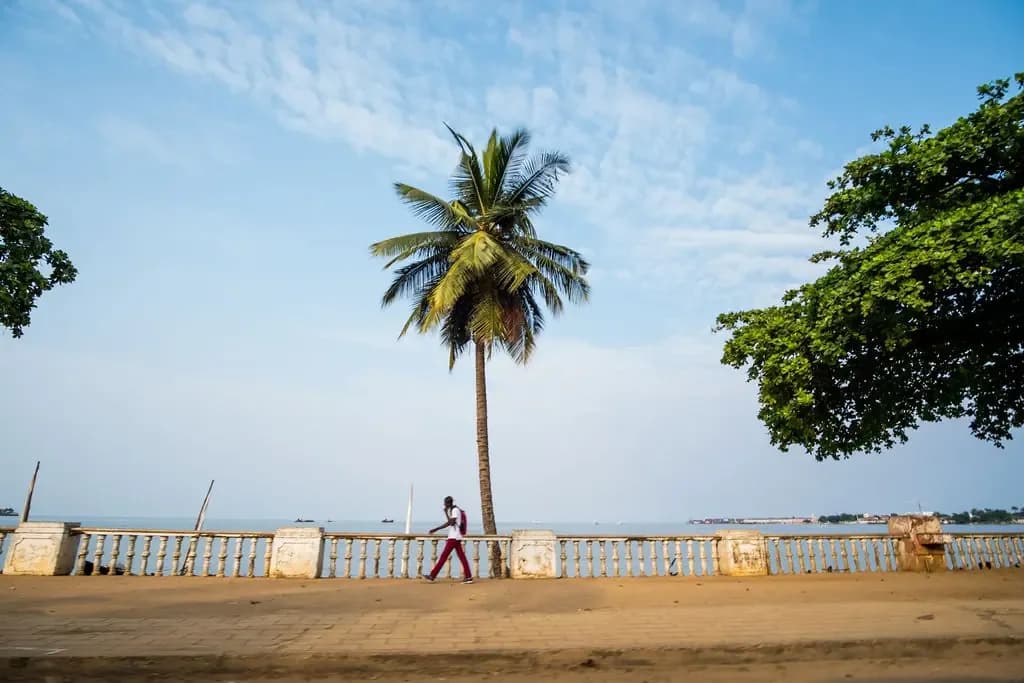
The seafront of São Tomé city, the capital, on Ana Chaves Bay. Photo: Príncipe Collection
What official travel advice says
The UK Foreign Office (FCDO) describes the crime rate as "generally low", while noting that burglaries and armed robberies can happen. It advises against carrying expensive jewellery or large amounts of cash, against taking valuables to the beach, and to keep documents in the hotel safe. It also warns that many roads are in poor condition and unlit outside the capital, and that taxis and motorbike taxis are often unsafe.
Portugal's foreign ministry, whose advice we follow closely because our trips depart from Lisbon, does not advise against travel either, but asks for caution:
- Security: it reports that security conditions have worsened in recent months, with more violent crime in every district, and advises prudence especially at night (street lighting is irregular or non-existent) and not walking alone.
- Flights to Príncipe: because of recurring disruption, it recommends travel insurance before going to Príncipe.
- Health: malaria and dengue are present; it advises a pre-travel medical consultation, repellent, clothing that covers arms and legs, and mosquito nets.
- Roads: motorbike taxis with poor safety standards, degraded roads and many vehicles in bad condition; it recommends travelling by 4x4.
The United States raised its advisory to level 3 in April 2026, citing political uncertainty ahead of the 2026 elections and limited health care, not crime against tourists. Citizens of the EU, Switzerland, the UK and the USA do not need a visa for stays of up to 15 days, and your passport must be valid for at least six months. See the details in São Tomé and Príncipe visa and documents.
Why it is still a peaceful destination
There are structural reasons:
- It is a small, isolated country. About 1,000 km² and just over 200,000 people in the middle of the Atlantic, with no land borders. Instability on the mainland does not reach it.
- There is no armed conflict or insurgency. Unlike the Sahel or northern Mozambique, there is no jihadist threat or guerrilla activity.
- It has been a stable democracy since 1990, with peaceful changes of power for more than three decades.
- Society is very close-knit. Everyone knows everyone, and the anonymity that helps crime in big African cities hardly exists here.
- People are welcoming to visitors. Portuguese is the official language, and our guides speak English, French and Spanish, so you can always ask for help.
In the interest of honesty: in November 2022 there was an attempted attack on a military barracks in the capital, resolved within hours and without affecting visitors. It is the kind of episode worth knowing about and putting in context.
Enjoying this article?
Get the day-by-day trip programme, with dates and prices
Sao Tome and Principe Tours: 8-Day Private Trip with a Local Guide8 days / 7 nightsfrom 1,250 €
Real crime: what happens and what doesn't
What is rare
- Armed robbery of tourists
- Express kidnappings
- Organised scams targeting tourists
What can happen
- Opportunistic theft: items left on the beach, in an unlocked room or in view inside a car.
- No transport at night: after dinner there are almost no taxis, so arrange your ride back in advance.
- Inflated prices at markets and in taxis if you don't agree the price first.
- Friendly persistence from vendors or informal guides near the capital's market.
In practice: São Tomé city is lively during the day and you can walk around in complete peace. At night there is no strolling: shops close around 8 pm, the streets empty as soon as it gets dark and there is practically no nightlife. Getting a taxi after dinner at a restaurant is almost a miracle, so arrange your return with the restaurant, hotel or guide (on our trips, a driver is included). And, as anywhere, don't flash expensive cameras or wads of cash.
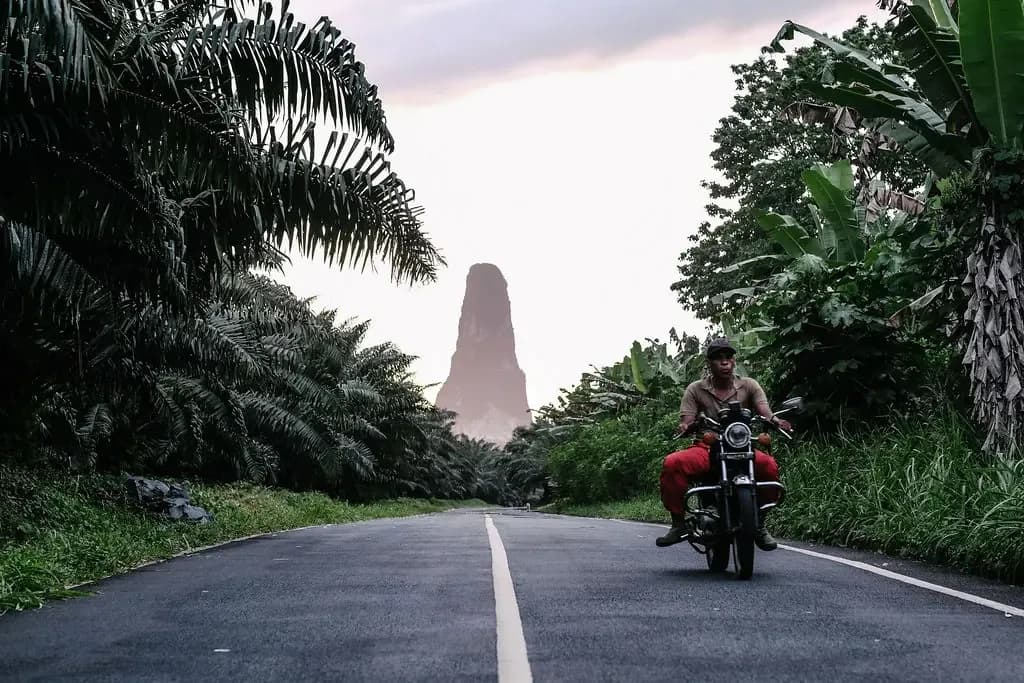
The road in the south of São Tomé on the way to Pico Cão Grande. Photo: Príncipe Collection
The risks you should take seriously
1. Malaria
It is the number one health risk and is present throughout the archipelago, although cases have fallen sharply over the last decade. See a travel clinic at least 4 to 6 weeks before you go to discuss prophylaxis, use DEET repellent from late afternoon, wear long sleeves and sleep under a net or with air conditioning. More in our complete guide.
2. Medical care is very limited
This is the critical point. Hospital facilities are limited and many medicines are not available. A medical evacuation to Europe costs tens of thousands of euros. Travel insurance with repatriation is not optional: it is the single most important precaution of the whole trip. Bring your usual daily medication.
3. The roads
The northern road is in good condition. The southern road, to Porto Alegre and Praia Inhame, deteriorates badly: deep potholes, dirt sections, narrow bridges and no lighting at all. Driving at night in the south is the most dangerous thing you can do in this country. A 4x4 with a local driver solves the problem.
4. The sea
Many beaches have no lifeguard and some have strong currents, especially on the north coast in the rainy season. Always ask at your accommodation before swimming at a beach you don't know.
As for animals, there are no large dangerous wild animals. The only venomous snake, the black cobra, lives only on São Tomé island and is rarely seen. We explain trail precautions in dangerous animals in São Tomé and Príncipe.
5. Water and food
Don't drink tap water or ice outside hotels. Peeled fruit and freshly cooked hot food are fine; salads washed in tap water may not be.
6. Power cuts
They are frequent and can last hours. Bring a head torch and a power bank.
Is it safe for women travelling alone?
Yes, and it is one of the African destinations where a solo female traveller feels the least friction. Street harassment is much less common than in North Africa, and the general attitude is one of respect and curiosity. The advice is practical: arrange night-time transport with your accommodation or guide, because the streets empty early and there are almost no taxis after dark, and go to the south of the island with your own transport or a guide.
Is it safe to travel with children?
In terms of crime, yes, and the people of São Tomé are extraordinarily welcoming to children. The difficulties lie elsewhere: malaria means talking to your paediatrician or a travel clinic about prophylaxis for children, the drives to the south are long and there is no paediatric emergency care outside the capital. For families with young children, an itinerary focused on the north and centre greatly reduces exposure.
How it compares with other African destinations
- South Africa: São Tomé has incomparably lower levels of violent crime; official advice for South Africa warns of high levels of crime.
- Morocco or Egypt: less sales pressure and hassle for tourists, but also much less infrastructure.
- Kenya or Tanzania: no terrorist risk or no-go areas, but no big game or safaris either.
- Cape Verde: similar levels of safety; São Tomé is far less touristy and has more limited health care.
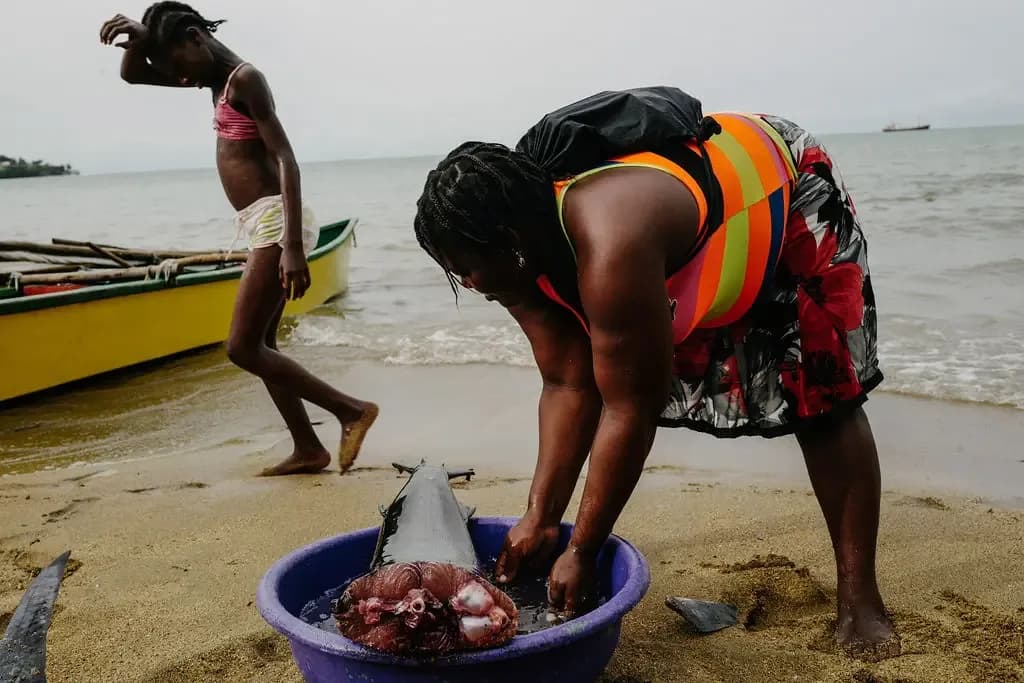
Freshly landed fish on a fishing beach in São Tomé. Photo: Príncipe Collection
10 practical safety tips
- Take out travel insurance with medical evacuation and repatriation. No exceptions.
- Register your trip with your government's travel service if it has one (for example, STEP for US citizens).
- See a travel clinic at least a month before you go.
- Use DEET repellent from late afternoon onwards.
- Don't drive at night, especially in the south, and avoid motorbike taxis.
- Bring euros in cash and change them into dobras; cards are only accepted in some hotels and ATMs are few.
- Keep your money in the hotel safe and carry only what you need for the day.
- At night, arrange a car back with the restaurant, hotel or guide: after dark there are almost no taxis.
- Agree the taxi fare before getting in.
- Download offline maps: the network drops out inland and in the south.
Prefer to drive? You can choose car hire in São Tomé by the day, with a 4x4 delivered to the airport, or the 8-day fly and drive, with car, accommodation and flights.
Frequently asked questions
Is it safe to travel to São Tomé and Príncipe in 2027?
Yes. São Tomé and Príncipe is not a violent country and neither the UK nor Portugal advises against travel; they recommend the usual precautions, especially at night, because street lighting is irregular. Travelling with a local guide and driver solves the transport question, which is the main difficulty after dark.
Is São Tomé one of the safest countries in Africa?
It remains among the most peaceful, thanks to the absence of armed conflict, terrorism and organised violent crime, alongside Cape Verde, Mauritius, Botswana and Namibia. We explain the ranking in the safest country in Africa.
Is there terrorism in São Tomé and Príncipe?
There are no active terrorist groups and no history of attacks in the country.
Which vaccinations are compulsory?
None if you travel from Europe via Lisbon. The yellow fever vaccine is only required if you arrive from a country with risk of transmission. The most important thing is malaria prevention, to be decided with a travel clinic.
Are the water and food safe?
Cooked food, yes. Tap water, no: always drink bottled water and avoid ice outside hotels.
Can I go out at night?
There is practically no nightlife. Shops in São Tomé close around 8 pm and, as soon as it gets dark, everything shuts and the streets are empty. Dinner at the hotel or a restaurant is the evening's programme and, as getting a taxi afterwards is very difficult, arrange your return with the restaurant, hotel or guide.
Is it safe to swim in the sea?
At most beaches, yes, but there are no lifeguards and some have strong currents. Always ask at your accommodation.
Is it true that the United States has a level 3 advisory?
Yes, since April 2026, linked to political uncertainty around the 2026 elections and limited health care, not to crime against tourists. The UK and Portugal keep more moderate advice.
Can you drink the tap water?
It is not recommended. The safest option is always bottled water, available throughout the archipelago.
Travel with local support
The simplest way to neutralise the real risks of this destination (roads, health, night-time transport, the unexpected) is not to be alone when they arise. We work on the ground with an official local guide throughout the tour, a 4x4 with driver and private trips, just for you and your companions.
Our 9-day São Tomé and Príncipe tour covers the north, centre and south of the island with everything taken care of, from €2,350 per person with flights from Lisbon. If you prefer to book your own flights, the 8-day São Tomé circuit costs from €1,250 per person (flights and insurance not included). See also the best time to go or get in touch with your questions.