
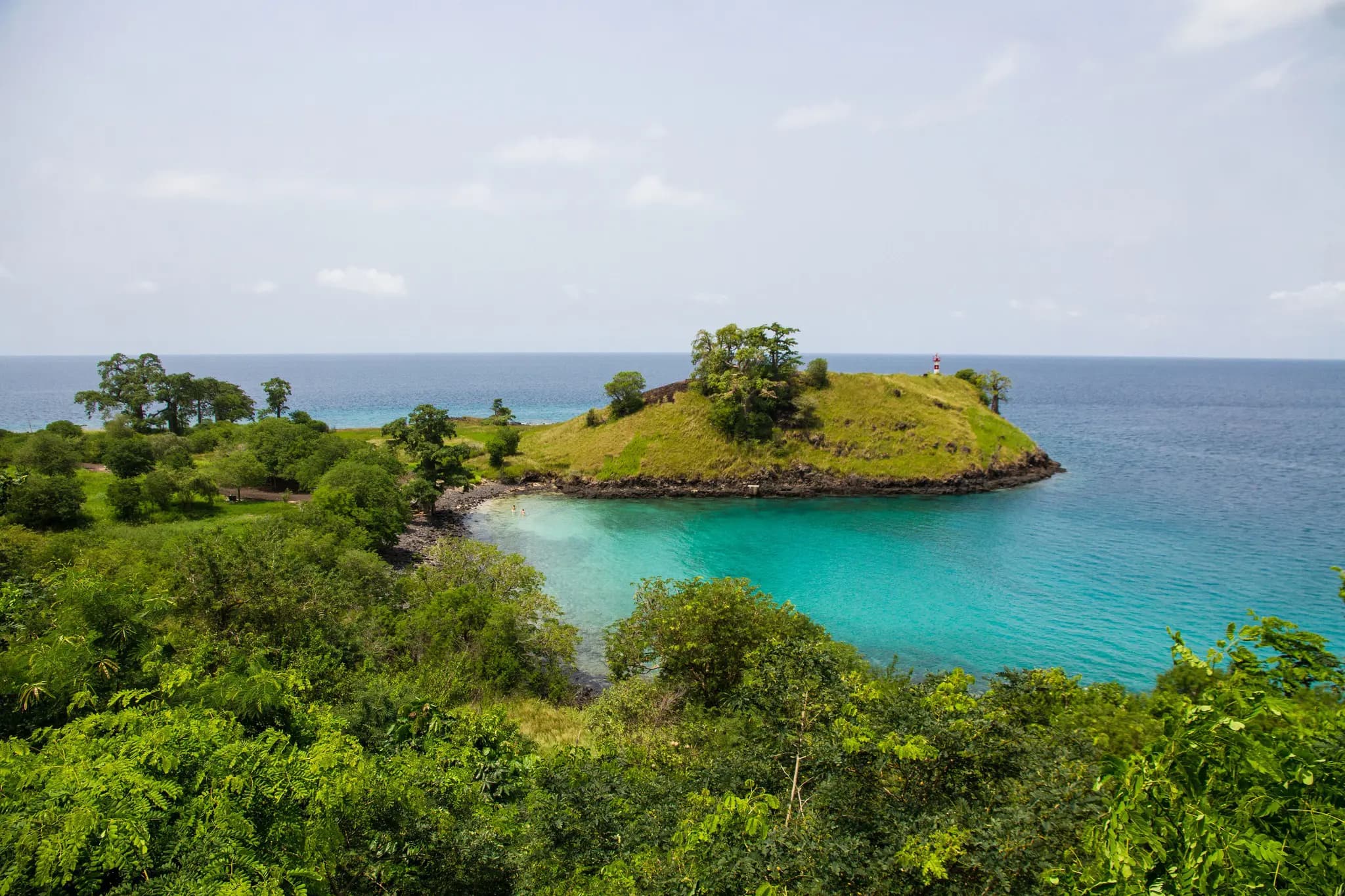
Everything you need to plan your trip to São Tomé and Príncipe: what to see, when to go, how to get there, how many days you need and budget — plus visa and health essentials.
If you're reading this, it's because São Tomé and Príncipe has appeared on your radar and you want to know where to start. That's completely normal — it's one of the least-visited countries on the planet, only a few thousand tourists arrive each year, and most travel guides don't even mention it.
This São Tomé and Príncipe travel guide brings together everything you need to plan your trip: what to see, when to go, how to get there, how many days you need and how much it costs, plus the safety, visa and health information that actually matters before you book. At the end, we share the itinerary we recommend ourselves after covering the islands point by point.
Where is São Tomé and Príncipe, and why is it so different?
São Tomé and Príncipe is a small archipelago in the Gulf of Guinea, off the coast of Gabon, made up of two volcanic islands covered in rainforest. It was a Portuguese colony until 1975, and that heritage shows in the language, in the architecture of the roças (former colonial coffee and cocoa plantations, many now converted into boutique hotels) and in the pace of local life, summed up in a phrase you'll hear constantly: leve leve — no rush.
Unlike other African destinations, there are no big hotel chains here, no crowded beaches, no signposted tourist routes. This is a destination explored with a guide, by 4x4, that rewards you with untouched rainforest, near-empty volcanic sand beaches and an authenticity that's increasingly hard to find on an organized trip.
When to travel to São Tomé and Príncipe (best time to go)
The climate is equatorial, so there's no real "bad" season to fly, but there are important differences worth planning around:
The Gravana (dry season) (June to September) — the best time to travel: clearer skies, less rain, roads in better condition and ideal conditions for the boat crossing to Ilhéu das Rolas. The short dry season (December to February) — a good alternative, with less crowding than the European summer and generally good weather. The rainy season (October to May, peaking in March–April) — intense but short tropical downpours, with the rainforest at its most lush and green. It's also the season for humpback whale watching (August–October, actually toward the end of the dry season) and sea turtle nesting.
In short: if your priority is good weather and trouble-free excursions, travel between June and September. If you don't mind the odd downpour and want to see the rainforest at its greenest, the rainy season has its own rewards.
What to see in São Tomé and Príncipe
The island is easier to plan mentally by route than by a scattered list of sights. These are the four areas that concentrate the most photographed — and most searched-for — spots:
The Coffee Route (island center) — the interior, climbing to 800 meters of altitude: coffee roças like Monte Café, the town of Cidade da Trindade and the Cascada Milagrosa, one of the most iconic corners of the interior.
The Cocoa Route and Blue Lagoon (north) — São Tomé was for decades the world's largest cocoa producer, and today you can visit a cooperative to see the full process. The route also includes the Blue Lagoon, the Baobab Route (Micondó) and Roça Agostinho Neto, the setting of Miguel Sousa Tavares's novel Equator.
The Paradise Beaches Route (south) — Pico Cão Grande, the country's most photogenic volcanic formation, Boca do Inferno and near-deserted volcanic sand beaches with the sea at 27–29°C.
Ilhéu das Rolas — a short boat ride from the south, it's the only place in the world where you can stand in both hemispheres of the Earth at once, right by the Equator Marker.
Add to this São Tomé city itself, with the São Sebastião Museum (a former colonial fort), Independence Square and its markets.
(If you want the exhaustive list of every beach, waterfall and roça on the island, blogs like Viajero Crónico or El Rincón de Sele have encyclopedic guides. Here we've focused on what really makes the difference on a one-week trip.)
How to get to São Tomé and Príncipe from Europe
There's no direct flight from most of Europe. The usual — and most convenient — route is:
A flight from your home city to Lisbon.
A direct TAP Air Portugal flight from Lisbon to São Tomé airport (about 6 hours).
It's a single connection, hassle-free, and usually the fastest route with the best value for money compared to alternatives via other African capitals.
How many days do you need? (recommended itinerary)
With fewer than 5 days, you'll barely have time to see the interior and one beach area. With more than 10, the leve leve pace starts to feel excessive unless you're planning to simply stay and rest.
The sweet spot is 8 days — just enough time to combine the four routes (Coffee, Cocoa, southern Beaches and Ilhéu das Rolas) without rushing the trip, including one completely free day to unwind on the beach.
That's exactly the itinerary we've designed for our 8-day São Tomé and Príncipe circuit: a local guide throughout the trip, a 4x4 vehicle, stays in boutique hotels and eco-lodges, and the four routes in this guide already organized day by day — so you don't have to improvise transport or logistics in a country where it's still difficult to get around independently.
Featured trip
Sao Tome Island Tour: 8 Days, Private with a Local Guide
Estimated budget
The three costs that weigh most on a trip to São Tomé and Príncipe are the international flight (via Lisbon), the guided land circuit (essential outside the capital given the lack of public transport and signage) and travel insurance with repatriation cover, which is non-negotiable given the state of healthcare outside the capital. Beyond that, individual meals, cocoa cooperative visits (around €4 per person) and local crafts are low-cost compared with other African destinations.
Security, health and visa: what you really need to know
Is it safe? Yes — São Tomé and Príncipe is considered one of the calmest countries in Central Africa, with very low crime against tourists.
Visa: most European citizens don't need a visa for stays of up to 15 days, with a passport valid for at least 6 months. For longer stays, there's an online e-Visa that should be requested at least 7 days in advance. A tourist tax of around €3.5 per night is charged at accommodations.
Vaccines: on a direct flight from Europe, yellow fever isn't mandatory, though it's recommended along with hepatitis A/B and tetanus. Malaria prophylaxis is also advised.
Travel insurance: it's essential that it includes medical repatriation, since healthcare infrastructure outside the capital is very limited.
Frequently asked questions
Can you visit São Tomé and Príncipe without a guide, independently?
It's possible, but complicated: public transport is scarce, many roads are unsigned, and a good part of the best routes (Coffee, Cocoa, Ilhéu das Rolas) require coordinating a boat, a 4x4 and access to private estates. Most travelers choose a guided circuit, at least for the bulk of the itinerary.
Is it an expensive destination?
It's more expensive than other "backpacker" African destinations because of its remoteness and low tourism volume (low supply = higher prices), but noticeably more accessible than other already-crowded African beach archipelagos.
Is there mobile coverage and wifi?
Limited outside the capital, especially at the eco-lodges in the south. It's part of the destination's disconnect-from-it-all experience.
What currency is used?
The São Tomé dobra (STN). Euros are accepted at plenty of tourist-facing businesses, and you can exchange currency on arrival.
Ready to plan it? Discover how all these routes fit into our guided 8-day São Tomé and Príncipe circuit, with guaranteed departures and small groups.
About Jaca Voyage Luxury Travel
Jaca Voyage Luxury Travel is a travel agency based in São Tomé and Príncipe, a partner of Vamos Fugir. Discover more about the brand at jacavoyage.com and follow us on Facebook and Instagram.