
Sao Tome Trekking: 8 Days of Rainforest and Cocoa Trails
Authentic 8-day hiking trip, level 2/3: Obô primary rainforest, Lagoa Amélia, the empty southern beaches and the Equator on foot · specialist guide throughout · from 2 participants
The trip
The route
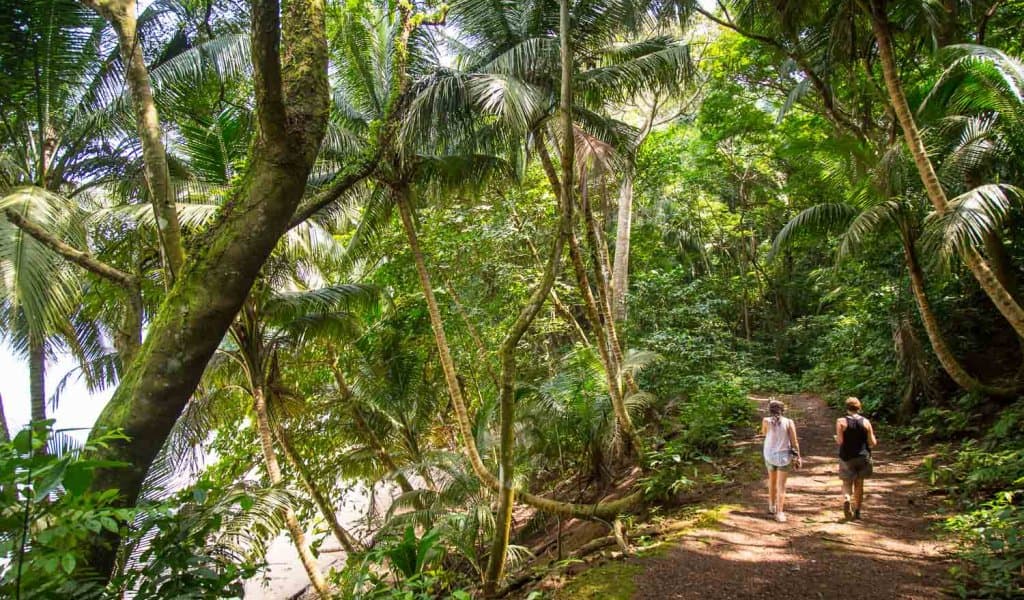
An 8-day walking circuit, level 2/3, with daily stages of 2h30 to 5h. You climb from the Bom Sucesso botanical garden to the crater of Lagoa Amélia inside Obô Natural Park, follow old plantation paths in the north down to the sea at Neves, walk between cocoa trees in the shade of giant fromager trees to Roça Santa Luzia, descend to the wild south along deserted beaches to the Malanza river mouth, and finish on Rolas Islet, on foot, right on the Equator.Sao Tome trekking level and conditions
The hardest day, Bom Sucesso to Lagoa Amélia, is about 5 hours with around 400 m of ascent. There are no technical sections, but the terrain is tropical: wet, muddy, with roots and natural steps, slippery after rain. Regular hiking experience on uneven ground is needed. Bring broken-in boots, poles, a light waterproof and a daypack. Times and climbs are honest estimates and the guide adapts each stage to the weather.Where you sleep and what's included
Seven nights in three different places: a charming hotel in São Tomé city, Roça Santa Luzia (reached on foot) and Praia Inhame Eco Lodge by the beach. Included: a specialist hiking guide every day, local guides on the trails, half board, 4x4 support, Obô park entry, the boat to Rolas Islet, the Malanza mangrove boat trip, coffee tasting at Monte Café, travel insurance and water on the trails. From €1,450 per person, land only; international flights are not included.Best time to hike
The dry season (gravana), June to September, is best: firmer trails and clearer skies. January and February offer a second drier window, the "gravanita". The trip runs from 2 participants, with a maximum of 12.Plan your trip
Read what to see in São Tomé and Príncipe and the climate guide. Prefer less walking? See our 8-day private tour.Itinerary
Day by day
Day 1
Day 1 · Arrival in São Tomé — first steps
Arrival in São Tomé in the late afternoon (direct flight from Lisbon, around 6h30, no time difference). You are met by the agency guide, helped with currency exchange and transferred to the hotel in São Tomé city. Welcome dinner with a briefing on the route, the kit you will need and the rhythm of the days ahead. No walking. Overnight in the city.
Day 2
Day 2 · Acclimatisation: Ana Chaves Bay and the capital's coast
A short, easy first stage to find your feet and gauge the heat: around 2h30 on foot along the waterfront and Ana Chaves Bay, past the São Sebastião fort and the old town, then out of the city on a coastal path. Flat ground, negligible ascent. Afternoon to rest and sort your kit. Overnight in the city.
Day 3
Day 3 · Obô: Bom Sucesso to Lagoa Amélia (the big day)
The hardest stage of the circuit, and the reason many people come. Setting off from the Bom Sucesso botanical garden at around 1,150 metres, you climb through primary forest inside Obô Natural Park to the crater of Lagoa Amélia at around 1,400 metres — an old volcanic crater whose floor is now covered by a floating carpet of vegetation you actually walk on. Around 5h of walking, roughly +400 m and −400 m, on mud, roots and natural steps, almost always under the canopy. Along the way, the island's endemic botany: marmulanos, giant begonias, wild orchids and tree ferns. Descent to Roça Monte Café, an old high-altitude coffee plantation, with a tasting of the arabica grown there. Overnight in the city.
Day 4
Day 4 · North: the plantation paths down to the sea at Neves
A mixed forest and coastal stage of around 4h, with moderate ascent. You follow the old service paths that linked the northern plantations to the coast, through abandoned groves and secondary growth, down to the fishing village of Neves against the sea, where lunch is fish and spider crab just off the boat. On the way back, a stop at Lagoa Azul, clear water over volcanic rock, and the route of the centuries-old baobabs standing alone in the dry northern landscape. Overnight in the city.
Day 5
Day 5 · On foot along the Cocoa Route to Roça Santa Luzia
Around 4h walking among cocoa trees in the shade of the fromagers — the giant trees that shelter the cocoa — along plantation tracks and secondary forest trails. Gentle ascent. You arrive on foot at Roça Santa Luzia, a restored cocoa plantation in the middle of the forest, where you follow the bean from harvest to drying and taste the white pulp of a freshly opened pod. Dinner and overnight at the plantation itself, forest all around.
Day 6
Day 6 · Down to the south: deserted beaches to the mouth of the Malanza
Down to the south of the island, the greenest and least populated part, stopping at the viewpoint over Pico Cão Grande, the volcanic monolith rising 663 metres above the forest. A coastal stage of around 3h30, along deserted beaches and trails between woodland and sea, to the mouth of the Malanza river and its mangroves. Check-in at Inhame Ecolodge, on the beach. A swim at the end of the stage and dinner at the lodge.
Day 7
Day 7 · The river trail and the Equator on foot, on Ilhéu das Rolas
A morning walking along the Malanza river, around 2h, followed by a boat trip through the mangroves with local guides, among roots, birds and silence. In the afternoon, the boat crossing to Ilhéu das Rolas and the walk up to the Equator marker raised at Gago Coutinho's request: the exact point where you stand with one foot in each hemisphere. Time on the islet's beaches before heading back. Dinner and overnight at Inhame Ecolodge.
Day 8
Day 8 · Praia Piscina, the market and departure
A free morning in the south, with Praia Piscina minutes away — natural warm-water pools between the rocks that fill and empty with the tide — for a last morning by the sea. Back to the city and a visit to São Tomé's Central Market, among fruit, roots, spices and tropical flowers, for any last purchases. Farewell dinner and airport transfer, with the overnight flight home.
What's included
- A specialist hiking guide from the first day to the last, whatever the group size
- Local guides on the walking stages, who know the trails and the island's botany
- Guaranteed departure from 2 participants (maximum 12)
- 7 nights' accommodation: boutique hotel in São Tomé city, Roça Santa Luzia and Inhame Ecolodge
- Meet and greet at São Tomé airport and return airport transfers
- Half board: breakfast and dinner every day, plus the lunches listed in the itinerary
- All the walking stages described, with 4x4 support for access and transfers
- Entry to Obô Natural Park and the Bom Sucesso botanical garden
- Boat crossing to Ilhéu das Rolas and the walk up to the Equator marker
- Boat trip through the mangroves at the mouth of the Malanza river, with local guides
- Visit to Roça Monte Café with a coffee tasting, and the Cocoa Route at Roça Santa Luzia
- Travel insurance
- Water during the walking stages
What's not included
- International flights to São Tomé (we can book them for you on request)
- Single room supplement (on request, subject to availability)
- Lunches not listed in the itinerary
- Drinks with meals
- Tourist tax of €2.10 per person per night, paid in cash at the airport on arrival
- Personal walking kit (boots, poles, daypack, waterproof)
- Personal expenses, laundry and gratuities
- Anything not listed as included
Frequently asked questions
All your questions answered
Level 2/3. Stages run from 2h30 to 5h a day, with the hardest — the climb from Bom Sucesso to Lagoa Amélia — at around 5h and roughly 400 metres of ascent. There is no technical ground and no exposure, but the terrain is tropical: humid, with mud, roots and natural steps, and slippery after rain. Anyone who walks regularly on uneven ground will manage this circuit comfortably. Anyone who never walks will struggle on day 3.
The gravana, from June to September, is the dry season and the best time to walk: firmer trails, less mud and clearer skies. There is a second drier window in January and February, the gravanita. Outside those periods it rains regularly — the island is green for a reason — and the forest stages become considerably harder.
Walking boots with good grip and already broken in, poles (they make a real difference on muddy descents), a light waterproof, a daypack, quick-drying clothing and insect repellent. Heat and humidity are constant, so you drink more than usual — water during the stages is included. We send the full list after booking.
They are reference estimates, and we say so plainly. On tropical ground the same trail can take considerably longer after two days of rain than in the middle of the gravana. The figures are there to convey the effort of each stage; the guide adapts the route to the day's conditions and may shorten or change a stage where that is warranted.
Lowland primary forest, among the rarest in Africa, inside Obô Natural Park; endemic species found only in this archipelago, from marmulanos to wild orchids; entire plantations given back to the forest; Pico Cão Grande, a 663-metre plug of solidified lava; and the Equator marker on Ilhéu das Rolas, where you stand with one foot in each hemisphere. All of it while barely meeting another walker.
Seven nights in three different places: a boutique hotel in São Tomé city for the central and northern stages; Roça Santa Luzia, a restored cocoa plantation in the middle of the forest, reached on foot; and Inhame Ecolodge, on the beach in the south, for the last two nights. On the last evening, after the farewell dinner, you transfer to the airport for the overnight flight home.
No. The price covers the whole programme on the ground, from your arrival at São Tomé airport. You're free to fly from your own city, use air miles or combine the trek with another trip. Direct flights to São Tomé leave from Lisbon (around 6h30, no time difference); if you like, we can book your flight so it lines up with the group's departure.
Entry requirements vary by nationality and we confirm them case by case at booking — the country operates an official electronic registration system. The yellow fever vaccine is recommended and may be required depending on your country of origin or transit. We send the full list of documents and health recommendations after booking.
The trip runs with a minimum of 2 participants and the group never exceeds 12. Whatever the group size, a specialist hiking guide is with you from the first day to the last, backed by local guides.
A typical local meal costs under €15 per person: grilled octopus, peixe-azeite or croaker, massada with grouper, arroz à moda da terra (rice the local way) or tuna. Grouper (cherne), the island’s most prized fish, costs over €15 per person. These are the everyday dishes, as Sao Tome cooking is mostly fresh fish. Meat is available too, but most of it is imported: if it matters to you, let us know in advance and we will arrange it.
Drinks are not included on our tours, except on a few special trips such as Christmas or the New Year’s Eve dinner. They are cheap: the local Rosema beer costs about 25 dobras (around €1) in many places, and 75 dobras or more in hotels, just over €3.